dart M Interface Description#
General Information#
The dart M interface is a Basler-specific interface. It comprises three components: the camera module, a flat flex cable (FFC), and either a Basler dart M Interface Board or custom hardware.
Camera Connections#
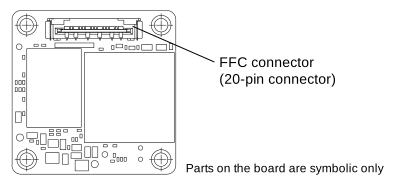
The interface to the Basler dart M camera module is a 20-pin FFC connector. The connector provides connections for image transfer via four differential signal pairs, input and output signals and power supply.
Flexible Flat Cable (FFC) Connector#
The 20-pin connector on the camera module is a flexible flat cable (FFC) connector by Hirose Electric Co. The connector order code is Hirose FH67 (FH67-20S-0.5SV) FFC/FPC connector.
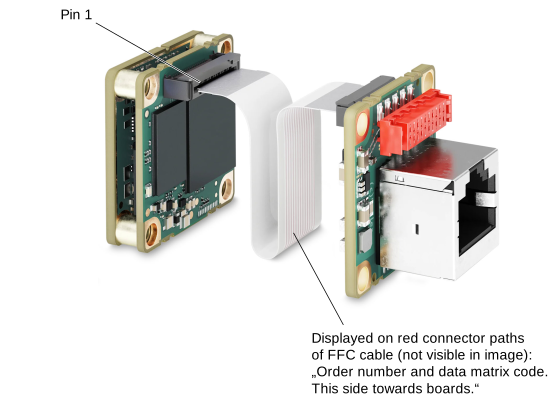
NOTICE – Wrong orientation of the FFC cable may damage the electronics.
The ends of the FFC cable are not specific, i.e., you can connect each end either to the camera module connector or to the connector of the interface board or of the dart M GigE switch. But it's important that you make sure to insert the cable in the correct orientation, i.e., the red conducting paths of the FFC cable must face the boards as shown in the following image. The image illustrates an interface board example, but the same principle applies to the switch.
FFC Connector Pinout#
In the image below, pin 1 of the FFC connector is indicated by an arrow.
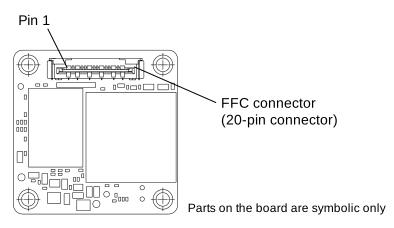
The Hirose FH67-20S-0.5SV connector provides twenty signal pins to support shielded FFCs/FPCs. These ground contacts are connected to the Basler dart M camera module's ground to provide return path for the power supply and to provide a stable reference plane for the impedance-controlled signals. The following table shows the details for these twenty signal pins.
| Pin # (Camera Side) | Pin Name | Function |
|---|---|---|
| 1 | VCC | Power Supplya |
| 2 | VCC | Power Supplya |
| 3 | LED | Status LEDb |
| 4 | - | Reservedc |
| 5 | - | Reservedc |
| 6 | Line 2 | General pupose output lined |
| 7 | Line 1 | General purpose input lined |
| 8 | GND | GNDe |
| 9 | D1+ | Data Interfacef |
| 10 | D1- | Data Interfacef |
| 11 | GND | GNDe |
| 12 | D2+ | Data Interfacef |
| 13 | D2- | Data Interfacef |
| 14 | GND | GNDe |
| 15 | D3+ | Data Interfacetf |
| 16 | D3- | Data Interfacef |
| 17 | GND | GNDe |
| 18 | D4+ | Data Interfacef |
| 19 | D4- | Data Interfacef |
| 20 | GND | GNDe |
-
Single camera supply voltage, 5 VDC nominal. Connect all pins.
-
Reserved for indicating camera module status
-
Reserved for future SLP use
-
Output can be used e.g. to control external lightning or to synchronize other cameras. Input can be used e.g. to trigger exposure.
-
All GND pins, including the six shield GND contacts on the opposite side of the connector, must be connected to a common GND plane. Avoid long PCB traces, prefer direct vias.
-
Differential data signals. Signal standard depends on Basler dart M camera module.
Status LED#
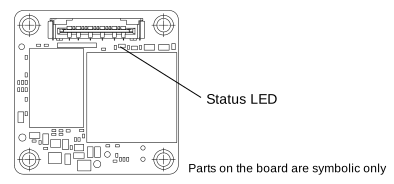
Indicates camera operation (LED lit = camera operating).
The LED can be turned off permanently by setting the DeviceIndicatorMode parameter to Inactive.
LED States#
| LED State | Meaning |
|---|---|
| Off | No power |
| Solid green | Powered, network connection established |
| Flashing green (3x short – 3x long – 3x short) repeatedly until error is corrected | System error (e.g., internal error) |
| Flashing green (3x long) repeatedly until error is corrected | User error (e.g., temperature error) |
| Alternating: Bright green / off | Link down (powered, but no GigE connection) |
| Alternating: Bright green / dark green | Allocating IP address |
| Solid green with a periodical, short dark phase | Network conflict |
Electrical Requirements#
WARNING – Electric Shock Hazard
Unapproved power supplies may cause electric shock. Serious injury or death may occur.
- You must use power supplies that meet the Safety Extra Low Voltage (SELV) and Limited Power Source (LPS) requirements.
- If you use a powered hub or powered switch, they must meet the SELV and LPS requirements.
WARNING – Fire Hazard
Unapproved power supplies may cause fire and burns.
- You must use power supplies that meet the Limited Power Source (LPS) requirements.
- If you use a powered hub or powered switch, they must meet the LPS requirements.
NOTICE – Incorrect voltage can damage the camera module.
You must supply camera and I/O power within the safe operating voltage ranges specified below.
Absolute Maximum Ratings#
| Pin Name | Absolute Minimum | Absolute Maximum |
|---|---|---|
| VCC | -0.3 VDC | 6.5 VDC |
| Line 1 | -0.4 VDC | 5 VDC |
Supply Current#
| Pin Name | Notes | Nominal (Recommended) | Maximum |
|---|---|---|---|
| VCC | Maximum power to be provided via the VCC pins is 6 W at 5 VDC nominal supply voltage. | Varies by camera module type | 1.2 A |
Input Voltages#
| Pin Name | Notes | Minimum | Nominal (Recommended) | Maximum |
|---|---|---|---|---|
| VCC | - | 4.5 VDC | 5.0 VDC | 5.5 VDC |
| Line 1 | Input low voltage | - | 0.0 VDC | 0.63 VDC |
| Line 1 | Input high voltage | 1.17 VDC | 1.8 VDC | - |
Output Voltages#
| Pin Name | Notes | Minimum | Nominal (Recommended) | Maximum |
|---|---|---|---|---|
| Line 2 LED | Output low voltage | - | - | 0.45 VDC |
| Line 2 LED | Output high voltage | 1.35 VDC | - | - |
Output voltages: When pins are not loaded. Observe voltage drop of internal 680 ohms series resistors.
GigE Data Interface#
| Pin Name | Function |
|---|---|
| D1+, D1- | MDI3 |
| D2+, D2- | MDI2 |
| D3+, D3- | MDI1 |
| D4+, D4- | MDI0 |
Pins listed above: 1000BASE-T IEEE 802.3 compliant phy MDI data pair with 100 ohms termination
Data Interface Trace Lengths and Delays#
The table below shows the trace lengths and approximated signal delays of the data interface on a camera module.
Info
Signal delay values were calculated assuming a signal velocity of 6 ns/m.
| Signal Name | Trace Length [mm] | Signal Delay [ps] |
|---|---|---|
| D1+ | 6.57 | 39.42 |
| D1- | 6.58 | 39.48 |
| D2+ | 6.59 | 39.54 |
| D2- | 6.62 | 39.72 |
| D3+ | 6.51 | 39.06 |
| D3- | 6.58 | 39.48 |
| D4+ | 6.70 | 40.20 |
| D4- | 6.63 | 39.78 |