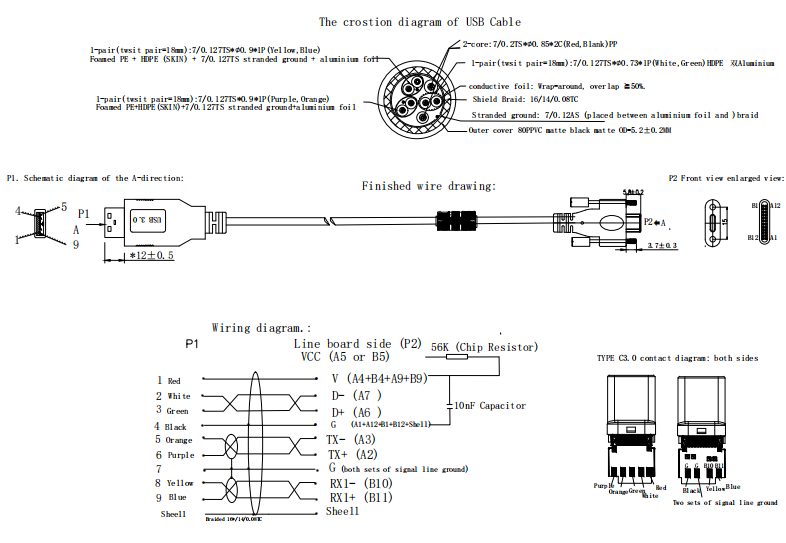
Reference Design: USB Cable#
- Signal line structure: In addition to the original power line and data line (D+, D-) of USB 2.0, USB 3.0 cables also provide four additional high-speed data channels to form a pair of SuperSpeed differential pairs (RX1+/RX1- and TX+/TX-). Supports full duplex data transmission up to 5 Gbps.
- Materials and quality:
- Conductor material should be high-quality copper wire, such as oxygen-free copper, to ensure low resistance and signal transmission clarity.
- Insulating materials should meet certain dielectric constant and dielectric loss to reduce signal attenuation and delay. Usually, materials with low dielectric constant (DK) are selected.
- The shielding layer must be tight enough to reduce electromagnetic interference (EMI) and signal crosstalk, which usually includes one or two layers of metal foil shielding layer plus ground braided layer.
- Wire color: The standard of USB 3.0 wire requires that the internal SuperSpeed difference should be blue to distinguish the outer skin of the wire, which is a unique identification of USB 3.0.
- Length limit: The USB 3.0 standard doesn't have a clear limit on the length of wires. Considering the influence of signal attenuation and noise, the length of cables shouldn't exceed 3 meters in practical engineering applications, which may affect the data transmission rate and stability.
- Interface compatibility: The USB plugs at both ends of the wire must conform to the USB 3.0 interface standard to ensure physical compatibility with the USB 3.0 device and must also be downward compatible with USB 2.0 devices.
- Electrical performance: The wire must undergo strict electrical performance tests, including signal integrity and consistency tests, to verify whether it meets various indicators required by USB 3.0 specifications, such as signal eye diagrams, radiation, static electricity, etc.
Reference design drawing